The Guide
Are Customers Finding You Through ChatGPT More Likely to Buy?
Are ChatGPT visitors really better for business? Here's what the research reveals about conversions, customers, and where to focus your marketing.
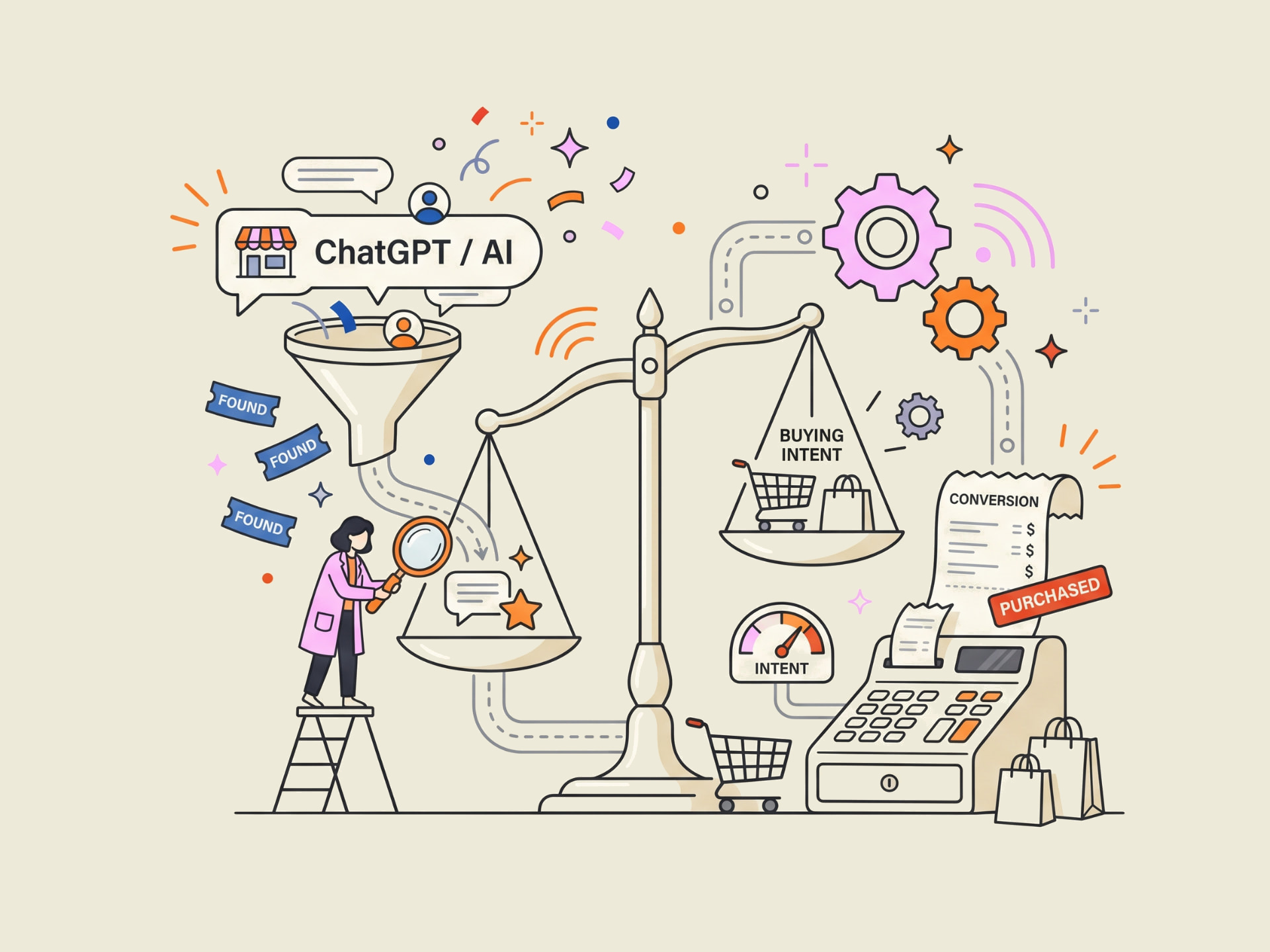
TL;DR
- Some research suggests ChatGPT visitors are more likely to take action than Google visitors. But higher conversion rates don't necessarily mean more paying customers.
- Google still generates significantly more measurable traffic and conversions. And the results for AI referrals vary depending on the type of business.
- Before shifting your marketing efforts toward AI search, look at what's actually bringing you customers. Understanding where your inquiries come from and what influences buying decisions is more valuable than chasing impressive conversion statistics.
You may have seen headlines claiming that visitors from ChatGPT are three, four, or even twenty times more likely to become customers than visitors from Google.
Sounds pretty promising, especially if you're wondering whether AI search visibility is worth investing in.
But here's what those headlines often leave out: A higher conversion rate doesn't necessarily mean more paying customers.
And when we look at the research more closely, the implications for business owners aren't nearly as straightforward as those headlines suggest.
The Headline Numbers
Are ChatGPT Visitors Really More Likely to Become Customers?
In October 2026, SEO expert Marie Haynes published an analysis of twelve months of Google Analytics data across 100 websites, representing more than 145 million website visits.
Of those websites, 55 were tracking conversions.
And the results were pretty remarkable.
13.8% of visitors from ChatGPT converted.
3.02% of visitors from Google organic search converted.
That's more than four times the conversion rate!
But before we get too excited, it's worth explaining what marketers mean by a conversion.
A conversion happens when someone takes an action a business wants them to take. That could mean making a purchase, submitting a contact form, booking a consultation, or signing up for a newsletter.
A conversion doesn't necessarily mean someone became a paying customer.
For example, someone booking a discovery call with a consultant is encouraging, but it doesn't mean they're going to become a client.
And that distinction matters when interpreting these studies.
Now, here's the really interesting part of Haynes's findings.
Even though ChatGPT visitors converted at more than four times the rate of Google visitors, Google organic search still generated 96.5% of the recorded conversions across the channels analyzed.
How is that possible?
It's actually pretty simple. Google was sending substantially more visitors to those websites.
Across the full 100-site dataset, ChatGPT referrals represented the equivalent of just 0.62% of Google's organic search traffic.
So while a higher percentage of ChatGPT visitors took action, Google was responsible for far more of those actions overall.
And that's an important distinction for business owners trying to decide where to invest their marketing resources.
It Depends on the Business
Not Every Business Sees the Same Results
Another reason to be careful with these headlines is that conversion rates can vary considerably depending on the type of business.
Think about the difference between someone purchasing a business software subscription and someone hiring a consultant to help develop their company's growth strategy.
Both might use ChatGPT to research their options, but their decision-making processes can look very different.
One might make a purchase relatively quickly. The other might spend weeks comparing providers, reviewing qualifications, and scheduling conversations before making a commitment.
And those differences are worth keeping in mind when looking at conversion research.
The SEO Works analyzed AI referral traffic across 95 websites, with 63 meeting the requirements for conversion comparisons.
Unlike Haynes's ChatGPT-specific analysis, this study included referrals from several AI platforms, including ChatGPT, Gemini, Claude, and Perplexity.
Across the 63 websites:
- AI visitors converted at 7.18%, compared with 6.08% for organic search visitors.
- B2B service businesses saw a modest advantage, with AI referrals converting at 1.21 times the rate of organic search.
- B2B product businesses saw the opposite, with AI referrals converting at just 0.62 times the organic search rate.
And perhaps most importantly, 23 of the 63 websites actually had lower conversion rates from AI referrals than from organic search.
So even within one study, the results weren't consistent.
There's also another important limitation: these studies generally measure actions recorded in website analytics, not whether those inquiries eventually became paying customers.
For a business selling professional services, a higher percentage of contact form submissions might be encouraging. But if those inquiries aren't coming from qualified prospects, they may not be particularly valuable.
The takeaway? Don't assume that because AI referrals convert better for some businesses, they'll automatically generate more customers or revenue for yours.
What Analytics Can Miss
What About Customers Who Use ChatGPT but Never Click Your Website?
There's another complication that's easy to overlook.
Not everyone who discovers your business through ChatGPT will click directly from an AI-generated response to your website.
Let's say someone asks ChatGPT to recommend an accountant specializing in tax planning for business owners.
ChatGPT includes your business among its recommendations.
But rather than clicking through to your website, that person opens Google, searches your business name, reads a few reviews, and then visits your website from the search results.
A few days later, they schedule a consultation.
In your website analytics, that visit might be attributed to Google, even though ChatGPT was where the person first discovered your business.
This is a hypothetical example, but it illustrates an important limitation of website analytics.
AI can potentially influence how someone discovers or evaluates your business without appearing as the source of their website visit.
There are technical limitations, too.
In October 2026, a temporary tracking bug caused some ChatGPT referrals to appear as direct traffic in analytics reports. A fix began rolling out on October 15, but the incident demonstrated how easily tracking changes can affect the numbers businesses rely on.
Of course, we shouldn't assume that every unexplained website visit originated from AI.
And I wouldn't interpret an increase in direct traffic or searches for your business name as proof that AI is sending you more customers.
The point is that referral traffic alone doesn't necessarily tell us everything that influenced a customer's decision.
And that's why I think business owners need to look beyond their analytics dashboards.
Next Steps
So What Should Business Owners Actually Do?
Rather than focusing exclusively on whether ChatGPT visitors convert better than Google visitors, I'd recommend starting with three practical steps.
01 · Traffic
See How Much Traffic AI Is Actually Sending Your Website
Before deciding whether to invest more in AI search visibility, take a look at how much traffic you're already receiving from platforms like ChatGPT and Perplexity.
If you're using Google Analytics, head to your Traffic Acquisition report and look at the websites sending visitors your way.
You can look for sources like chatgpt.com or perplexity.ai and compare those visits with the traffic you're receiving from Google organic search over the same period.
You might discover that ChatGPT is already sending visitors to your website. Or you might find that AI referrals account for only a small portion of your overall traffic.
Keep in mind that these reports won't capture every customer who discovers your business through AI, so don't treat the numbers as the complete picture.
The goal is to understand where you stand today before deciding where to invest more of your marketing time and money.
02 · Results
Look Beyond Website Traffic to See What's Actually Generating Business
Knowing how many people visit your website is helpful, but what happens after they arrive is even more important.
If you're using Google Analytics, take a few minutes to confirm that you're tracking meaningful actions on your website.
For service-based businesses, that might include contact form submissions, consultation bookings, or requests for proposals.
For an online retailer, purchases and revenue may be more useful than simply tracking website visits.
But I'd encourage you to look one step further.
How many of those inquiries are qualified? And how many eventually become paying customers?
Even a simple spreadsheet can help you get started.
Track your inquiries, where they came from when that information is available, which ones turn into opportunities, and which eventually result in new business.
Then compare what you're learning with your website analytics.
For example, if Google continues to generate most of your qualified inquiries, that's a good reason to keep investing in the SEO work that's already producing results.
If you start seeing meaningful inquiries or purchases from AI referrals, that's worth paying attention to as well.
The goal isn't just to identify which platform has the highest conversion rate. It's to understand which marketing efforts are actually contributing to your business.
03 · Content
Create Content That Helps Customers Decide Whether You're the Right Fit
Rather than publishing content simply because you think ChatGPT might reference it, think about the questions your customers ask before deciding to work with you.
What comes up repeatedly during discovery calls?
Are people asking about your pricing, your process, what makes your approach different, or whether you've worked with businesses like theirs?
Those are great starting points for website content.
For example, a consultant might create a page explaining what happens during an initial engagement, who benefits most from their services, and what clients can expect from the process.
A professional services firm might publish a case study showing how it approached a particular client challenge and what the outcome was.
This gives prospective customers useful information for evaluating their options, whether they found your business through Google, ChatGPT, or a referral.
It also makes information about your services easier for search engines and AI systems to access and interpret, although publishing this content doesn't guarantee AI citations or recommendations.
The goal is to make it easier for the right customers to understand why your business might be a good fit for them.
The Bottom Line
The Real Goal Isn't a Higher Conversion Rate. It's More of the Right Customers.
So, are customers finding your business through ChatGPT more likely to buy?
The research suggests that AI-referred visitors sometimes take action at higher rates than Google visitors, but that doesn't necessarily mean they're generating more paying customers.
And the results vary considerably across businesses.
That doesn't mean AI search isn't worth paying attention to.
It means we need to be thoughtful about what we're measuring and how we're using that information to make marketing decisions.
My recommendation is to keep investing in the channels that are already bringing you qualified customers, while making sure your online presence supports the ways people are increasingly researching their options.
That means having a website that clearly communicates what you offer, content that answers your customers' questions, and credible information about your business wherever people might encounter it.
You don't necessarily need separate marketing strategies for Google and AI search.
You need a connected approach that helps people find, understand, and trust your business.
Because ultimately, the goal isn't to win a conversion-rate competition between Google and ChatGPT. It's to attract more of the right customers.
Next Step
Not Sure Where to Focus Your Marketing Efforts?
If you're wondering whether your website and broader online presence are helping you attract the right customers through Google and AI search, that's exactly the kind of challenge I help businesses work through at SPOKE Strategies.
Feel free to send me a message if you'd like to chat about where to focus your efforts!
Schedule a conversation